Showing posts with label Meta. Show all posts

NOT TODAY, ASTAROTH

Negative thought patterns, expectations, comparisons, self-doubt & self-criticism…

You will overcome them eventually,
so any time or energy spent on them is wasted.

Stay vigilant for their return, recognize their signs,
let them glide off your mind.

If they persist - record, interrogate, break them down,
& their power will dissolve.

Deciding and figuring out how to format the above took me twice as long as writing the post. This is still a huge reason I don't blog more -_- 

This is a Tenet of Foolish Endeavor. 

One of a set of guiding principles I've created for myself, to fall back on when things aren't going great on this new quest of mine. I may share more in the future.

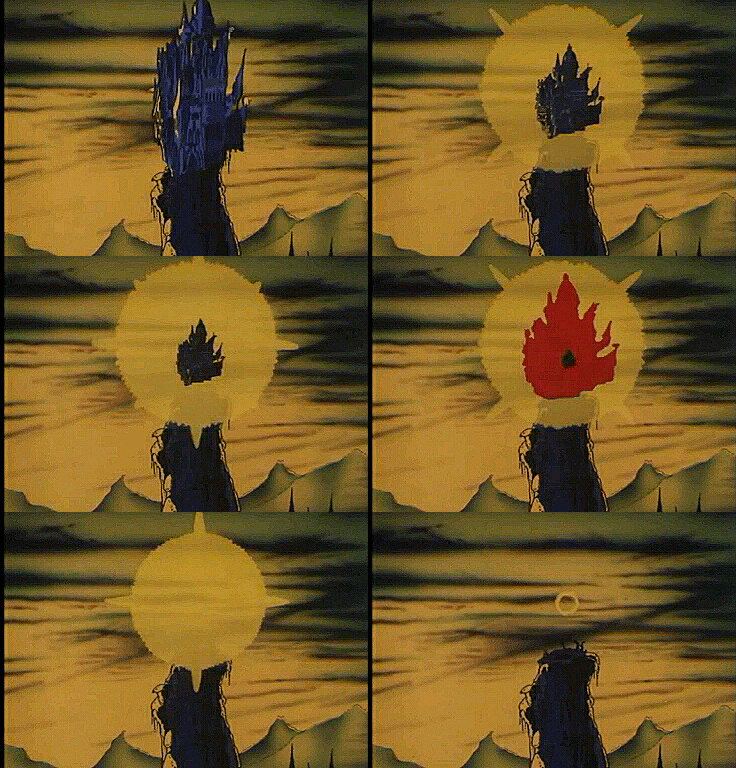
I've finally started getting good at catching negative thought patterns and simply saying "Not Today", and they immediately dissipate. I've heard people call that voice their something along the lines of Asshole Brain or their shitty little mind goblin. Which made me wonder if there was a demon associated with this kind of thing. The closest I found is Astaroth, associated with self-doubt.


This is the guy keeping you down? C'mon.

Also he looks so dumb. Look at this dweeb. His dragon looks like a doggo with a permablep and balls for a nose. I think he's not even on board with this guy's bullshit.

So when you catch yourself having unhelpful thoughts, think
"Nice try, Astaroth, but Not Today"
and move on with making progress and enjoying life to the best of your ability.

Has this helped me publish projects or blog more? 

...that's... not the point of this post.

Minimal Effort Joesky Tax: The Voice of Astaroth

When a PC gains the attention of demons in some manner, they may attract The Voice of Astaroth. This is a curse that prevents them from attempting significant, voluntary challenges unless they pass a Save vs Paralysis. After a successful save, the Voice is quelled... until they fail at another significant, voluntary challenge. Or sunrise. Whichever comes first.

I Quit My Job To Make Games

Or, I Finally Beat Inspiral By Nerfing Workdays


TLDR: Foolish Endeavor is how I will polish & publish Game Things in a personally sustainable manner: iterative, meandering, & unbound (read as "very ADHD").
Join the mailing list! Here's the first game I'm actually proud of!


The title is a slight exaggeration; there are many contributing factors for me leaving traditional gainful employment (including, I am constantly grateful to say, sufficient financial stability). But I am indeed, as of July last year, a full-ish-time, self-employed, (un)"professional" game designer, working under an unregistered but aptly named publishing imprint (for lack of a better term for this amorphous entity) that I have spoken into existence: Foolish Endeavor

Read much more below.

Embarking on a Foolish Endeavor

Over the second half of this year, I've started to get serious (and "full time") about finally polishing and publishing thinky-adventurey games, dungeons, supplements, and other unusual interactive curiosities from my deep, forsaken library of a backlog of nascent projects.


It will be a long and winding path. If you'd like to avoid exposure to the toxic hellsites, or not need to remember to check the blog, sign up to the newsletter be the first to hear about my project releases and works in progress, and maybe even some extra bits of gameable content!


 And stay tuned for a more substantial announcement. I'll be incredibly disappointed in myself if it doesn't come by the end of this year.

Feeling Foolish, Might Delete Later

Plans are drawn. 
Boots are donned. 
A step is taken. 

An Endeavor begins. 
One week.

Inspiral - A game about (not) making stuff

I've been feeling bad about not making (well, releasing) stuff, so today I made a game about (not) making stuff. It's unbalanced and untested, but I'm releasing it to remind myself that it's something I can do.

Inspiral


Maybe I'll Just Make A Dungeon: Getting Over Myself

Well, there was a time when I wanted to keep this style of writing off my blog, but it seemed to help me actually write instead of endlessly edit, so...

So I Want To Make A Dungeon? Just follow these [insert final number] simple steps!

Be Warned: This only superficially and sarcastically resembles a step by step procedure that I would recommend following. I may or may not revise it into one later. I've been working on this pretty much constantly since my earlier post, and so this is an artificially re-organized and dramatized version rather than a real-time log.

Step the First: Decide to really make something instead of constantly brainstorming on yet another amorphous project I get distracted away from and build up anxiety about not finishing

Return from an RPG info-sphere hiatus and come across a couple of genuinely inspiring posts on making dungeons at the equally indispensable Swamp of Monsters and Papers & Pencils. Remember Bryce's Black Maw experiment. Remember I saw a few neat dungeon-building "games" recently - Ex Umbra and Delve / Rise.

Think "Hey - maybe I'll just make a dungeon. I've never really done it before despite how much I've read about and thought about dungeon design. It might even be a nice, chill past-time exercise, like a crossword puzzle; just following procedures and progressively fill in some gaps. Some nice soothing distraction from our IRL hellscape."

Decide to keep it vanilla, trope-y, not get my head too high in the clouds with heady artpunk/OSR-envelope-pushing concepts. Focus on making something Bryce wouldn't pan. Use the lingua franca of BX and put my handy OSE books to good use. Keep it to one level (though we'll definitely want to have multiple floors/sub-levels for some good verticality. Every time I see a dungeon restricted to one lateral, level I nope out.)

Spend sometime revisiting  some old links and compiled dungeon design notes from around the blogosphere of the last decade (Philotomy's advice, Melan diagrams, Jaquaying the Dungeon, Goblin Punch's Checklist, Blackrazor's Stocking Method, a bunch of others), and honestly come up short on good fully "worked" examples of a well-rounded old school dungeon. (Fittingly, I saw only yesterday that Necropraxis agrees after reading the exact same posts that inspired this project. Though the recent Gygax 75 Challenge comes close. Note that I'm not sure I actually intend to fill this gap with this series - the dungeon itself takes precedence!) 

So less a simple, relaxing exercise, but between all the resources and my own design thoughts, I think we can work this out. 

Step the Second: Prevent Blank Page Syndrome AND Icarus Syndrome by just getting something concrete to start with

All of my backburner dungeon projects have started with ideas for central features and themes, or a rough shape of a map. Moon College started with the idea of a bunch of thematically related magic items. Its map was literally shaped around them.

And I've always assumed if I ever made a "whole package" dungeon that I'd be meticulously designing the map layout myself, (and I will almost certainly be doing that after this exercise). Starting from an "externally sourced" dungeon feels... pedestrian.

But partly inspired by the Papers & Pencils guide, and given the self-constraining nature of this project, I decided to turn things upside down and just start with a pre-made map. And not just any pre-made map. A random Donjon map.

I've always kind of written off Donjon as being too random and vanilla, and it really is, particularly the room contents. And you're also locked into its rigid generation rules.

However, after playing around with the advice from Papers & Pencils, I did find some sweet spots in the generator settings that spat out some layouts I didn't hate.


And! I discovered that Mipui, an online map editing tool we've been using in the Castle Xyntillan game I've been playing in, can import maps from Donjon.

Mipui doesn't have the most intuitive or... nuanced toolset, and it can be visually buggy and slow even with modestly sized maps, but it's definitely the most comfortable tool for editing old school dungeon maps I've found - at least online. And its image exporting is pretty good, if you don't need any fine detail beyond what the tools it supports. I definitely intend to reproduce the map in another tool, maybe Tiled, or actually hand-draw it, since that's another thing I haven't really done since childhood despite my latent, 1.6 decade-old (insert gasp and sigh of despair) Art & Design college major.

I also intend to produce two maps - one for the GM (with optimal iconography and notes for running) and one suitable for displaying to players in a VTT or cut up and assembled at the table while playing (no secrets). That's another pet peeve of mine - a lot of effort and artistry goes into creating some beautiful maps that only the GM gets to see! It doesn't take much to get those to a condition that they can be very simply used in Roll20, as long as you aren't using "S"s that stick out of walls, or crossing passages over each other.

So I generated a few Donjon maps and settled on one that spoke to me. It's far from great, but all we're really looking for here is a starting point for a dungeon that already has good looping, flow and multiple routes, and some good variety in layout.

The Donjon map imported to Mipui
 

Step the Third: Start tweaking, and then stop tweaking

Get rid of the most glaring absurdities. The passages that lead back into the same room, the ridiculously long linear corridors, the dead ends (should have used the "no dead ends" setting) - this isn't a funhouse dungeon.

Starting adding some flare and non-standard shapes. But don't get obsessive about the layout yet. I'll revisit how and why I refine certain aspects later.

Snip snip... ah, much better.

This step, at least, was nice and relaxing - in the same way as fixing up a wonky generated Minecraft village.

Many more steps to come - if I'm up for it. I've got an outline of everything I've done so far, but don't want to Icarus up this post before I Icarus up the dungeon itself.

I encourage you to comment below, rather than elsewhere.

Long live the Blogosphere!


Maybe I'll Just Make A Dungeon

After a bit of a hiatus from keeping up with the RPG-sphere (and not feeling motivated enough to get any of my own projects - or 15 draft blogposts, or eleventy billion notional-but-potentially-gameable brainstorm/shower-thought notes - into a shareable state), I've been inspired by a few recent dungeon design posts, actually getting some good OSR dungeoncrawling under my belt, and playing around with some tools. Before I knew it, I've got a foundation for a dungeon that I like well enough to try to build out and complete.

It's fairly vanilla, likely only one level, and doesn't involve any particularly special concepts, but I want to try putting into practice some of the guidance I've accumulated over the years, as well as my own design gripes and druthers. Particularly since I've never really created a "whole package" dungeon, beyond a few small experiments, heady ideas for more high-concept projects, and Moon College.

And right now my pendulum has swung toward feeling like it's better to create gameable content and contribute to the B/X Commons than to work on hacks and systems, which is what I find myself usually inspired to do, but is more prone to Icarus Syndrome. Even if it ends up workmanlike; walk before you run and all that.

In addition to the dungeon, I'm hoping to refine some processes for both design and production that I will share either along the way or near its completion.

It will be a good-old, tropey Dwarf Stronghold (which I feel like is underrepresented these days?), focus on a gather-the-macguffins to unlock [a treasure or access to deeper dungeon at GM's discretion], and the working title is currently:

The Seven

and Dreg

 
No guarantees. My modus operandi is to get T-boned by something shiny in a nearby genre.

Just Some Advice for Running Low-Prep RPGs

From a sophomore GM of mostly old-school style games.
  • Top priority: Run what excites you, the GM. The game runs on your brain, so that energy influences every aspect of the experience. In its absence the game will fall apart sooner or later.
  • Don't expect your first (or 50th) game to be like Critical Role.
  • But if possible, watch/listen to an Actual Play video/podcast for the game or module to get familiar with its content, (one way) how to present it, and ways the players might respond.
  • Make your first games "one-or-more-shots"; a one-time thing with the option for a followup session. Don't worry too much about wrapping things up neatly; it's tougher than it seems.
  • Run a ruleset and module that's well-organized and easy to reference at the table. If it isn't and you still want to run it, reformat it in Google Docs and print out reference sheets. Prime example of a well-organized and presented ruleset: Old School Essentials. Examples of easy-to-run modules: Tomb of the Serpent Kings, Fever Swamp, Through Ultan's Door.
  • Have a discussion about expectations at the start of (or before) the game: what kind of game it will be, how it might differ from games the players have experience with, the "verbs" (what kind of activities you expect the characters to get up to), the tone, content notes. Discuss and use safety tools if there's any question of whether they might be helpful.
  • If you're interested in old school style gameplay, which generally emphasizes exploration and creative problem solving over satisfying storytelling or crunchy tactical combat, check out Principia Apocrypha for a bunch of advice. 
  • Part of why I like old school style games is that they're generally low-prep. Rules are usually simpler, you're not writing a grand, sweeping tale with a personalized character arc for every player, you don't need to know the population of every village in the kingdom or the name of every god. You're just some broke knaves in a dirty hole trying to get find treasure to pay for some armor so you don't get killed as soon as you set foot in the next hole. When the stakes are low, so is the prep; a little goes a long way.
  • Unless you definitely want a super-detailed world and/or plotted-out storytelling, you can cut down on prep with liberal use of random tables to fill in circumstantial details on the fly. In combination, they can even produce situations that are more interesting than you'd think to come up with on your own anyway. A superb, cheap, comprehensive source for random tables is Maze Rats (also a great rules-light old school style RPG)
  • My favorite note/prep organization app is workflowy.com - I'd be helpless without collapsible, draggable, hierarchical, nested notetaking. That said, it's not exactly effortless to reference or edit while running.
Normally I wouldn't think topost on such a basic/ubiquitous topic, but a local group is getting together soon to discuss GM prep, and I was taking notes to bring up for it. Suddenly, content!

I encourage you to comment below, rather than elsewhere.

Long live the Blogosphere!

What We Talk About When We Talk About The OSR

Regardless of the wishes of the OSR's prominent proponents, whatever they might be, the term OSR has become irrevocably applicable to a plethora of interrelated but distinct concepts. Necropraxis held a survey in 2018 where respondents rated how much they felt "OSR" referred to eight separate meanings. But eight is (necessarily for the purposes of a survey that folks will actually complete) reductive, compared to what I think the term encompasses, or rather, is applied to by individuals.

As they say, "ask a hundred people what "(the) OSR" is and you'll get a hundred different answers". So here's my stab at putting those hundred answers in one place. Though, this list sprang from my own mind, so I'm just one of those hundred. I'd love to know if anyone's done a similar analysis that identified aspects that I missed here.


Kircher's Tree of Life

I'm aiming to take a mostly-objective stance here; this is meant to be a resource for disambiguation and a reference point for other discussions. Any strong opinions I have I will be put forward in a separate post. This isn't particularly well-polished, barely more than my initial thoughts as I was formulating them (else this would never see the light of day as I tweaked it into oblivion). Likewise I'm not putting much effort into researching historical accuracy, so let me know in a comment if I have details wrong or have more context to share.

The only tidbit of opinion I'll express here, in the chance that I never feel comfortable participating more deeply in the discourse, is that in talking about changes in the RPG space, please, PLEASE try to use more precise language around what exact aspects of the OSR you're discussing. You don't have to use these terms, but I expect many disagreements and confusions to dissolve once all participants actually know what each other is talking about. Because it's not an atomic thing. It's a vast, amorphous concept, whether or not we want it to be.

Alignment as the effect of a spell

Align Soul

Cleric/Divine, Level 20
Duration: Permanent until overwritten by this spell or overridden by the target's volition (see below)
Range: Infinite within plane

Enchant an individual with an aura of, and variably strong inclinations to follow behaviors circumscribed by, an Alignment of Law, Chaos, or Neutrality, and (optionally) fluency in a language known only by others of the same Alignment.

The individual may at times act against those circumscriptions, but in extreme circumstances may be compelled after an introspective struggle (roll under WIS/CHA or save vs magic, etc).

After a series of such struggles, their Alignment may change toward that associated with the individual's actions.

Conceptual Status: Warning - Notional Idea

Commentary

Alignment is a perennially debated topic, but I was struck by the notion of looking at it from a different perspective. If magic exists, perhaps Alignment could be tied to the effect of a spell, like a cosmic-level "Charm Person". This explains both its ability to be "detected" and other mechanical interactions, while leaning into, instead of dodging the fact that it feels "artificial".

Why can't I hold all these wizard towers

Ardmore Round Tower

Summon Wizard Tower
Magic User, Level 1
Duration: Until sunrise
Range: 500’ on ground under open sky

A wizard tower that has been placed under the “Bind Wizard Tower To Summoning” enchantment (which one exactly depending on the vagaries of cosmological fate) erupts from the ground 500’ away from the caster. At the next dawn, sunlight causes the tower and anything summoned with it to dissolve, returning whence it came. If someone who enters the tower writes up a session report describing their explorations, tribulations, and likely death and shares it with the OSR community and/or creator of the tower, they receive XP equal to 500 multiplied by the (lowest) character level intended for the tower.

Bind Wizard Tower To Summoning
Magic User, Level 5
Duration: Permanent
Range: Touch

The creator of a wizard tower writes it up as an adventure module and shares it with the OSR community. The tower then becomes summonable by the Summon Wizard Tower spell. Details of session reports from explorers of the tower via the Summon Wizard Tower spell may alter or add treasure or magic items to the tower in the creator’s world, and subsequent summonings.

Some pre-bound Wizard Towers ripe for the Summoning: